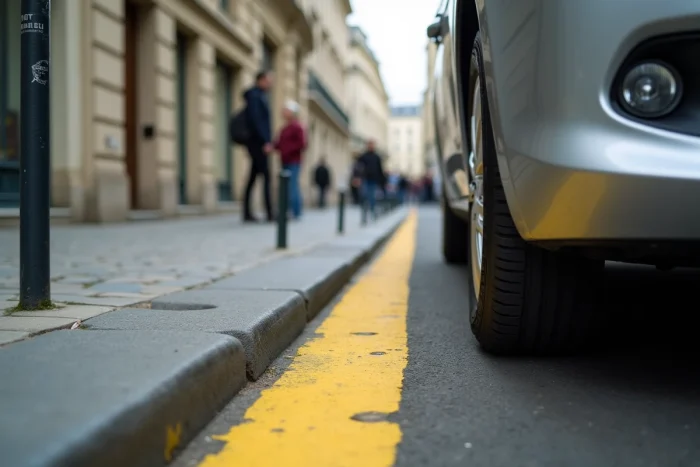
Between the solid yellow line painted along a sidewalk and the broken line a few meters further, the difference in treatment can be costly. Each variant of the yellow marking corresponds to a distinct prohibition, accompanied by penalties that vary depending on the municipality and the type of offense.
Understanding what each marking allows or prohibits helps avoid a post-parking fee, the amount of which, since 2018, directly depends on local pricing policies.
Penalties Based on the Type of Yellow Road Marking: Comparative Table
The Highway Code distinguishes several configurations of yellow markings. Each results in a different level of penalty, and the confusion between stopping and parking often increases the fine.
| Type of Yellow Marking | Prohibition | Base Penalty | Risk of Towing |
|---|---|---|---|
| Solid yellow line (along the sidewalk) | Parking AND stopping prohibited | Fine or post-parking fee depending on the municipality | Yes (towing possible) |
| Broken yellow line (along the sidewalk) | Parking prohibited, stopping allowed | Fine or post-parking fee depending on the municipality | Yes if parking is prolonged |
| Yellow zigzag (in front of schools, bus stops) | Parking AND stopping prohibited | Fine or post-parking fee depending on the municipality | Yes |
| Yellow barred area | Parking prohibited in the area | Fine or post-parking fee depending on the municipality | Variable depending on municipal order |
The central distinction lies between the solid line and the broken line. The former prohibits any immobilization, even with the engine running. The latter tolerates a brief stop to drop off a passenger or unload, but not parking.
The rules regarding parking on yellow lines are based on this logic: the ground marking takes precedence over local habits, and the absence of a vertical sign does not exempt one from respecting the marking.

Post-Parking Fee and Variable Amounts Depending on Cities
Since the implementation of the post-parking fee (FPS) in 2018, municipalities freely set the amount of the penalty for unpaid or prohibited parking on public roads. This transfer of authority has resulted in notable discrepancies from one city to another.
Paris has raised the amount of the FPS several times, including in areas where parking is strictly prohibited. Lyon, Bordeaux, Nice, and other major urban areas have followed similar trajectories. The result: parking on a yellow line in Paris costs significantly more than in rural areas.
In practice, the FPS replaces the old fixed fine for offenses related to paid parking, but parking on a solid yellow line can also fall under a classic offense (stopping or obstructive parking, or even very obstructive depending on the context). The two regimes coexist, and the applicable penalty depends on the classification made by the officer or the control device.
Automated Control and Increase in Penalties
Since 2022, several cities have deployed vehicles equipped with automatic license plate readers (LAPI). These “scanning” cars patrol the streets and detect vehicles in violation without direct human intervention. Paris, Montpellier, and Reims are among the municipalities that have adopted this system.
Reports from these municipalities indicate a significant increase in the number of FPS issued each year since the deployment of LAPI, particularly along sidewalks marked in yellow. For a driver, the likelihood of receiving a penalty after just a few minutes on a yellow line has therefore greatly increased in these areas.
Challenging an FPS for Non-Compliant Yellow Marking
A ground marking is not always reliable. The paint fades, construction alters the markings, and some lines do not comply with current technical standards. This point has direct legal consequences.
Since 2020, several decisions from local courts and administrative tribunals have confirmed that a faded or non-compliant yellow marking can lead to the cancellation of the penalty, even when a vertical no-parking sign is present nearby. The judges’ reasoning is based on a simple principle: signage must be readable and coherent to be enforceable.
Elements to Check Before Contesting
- The condition of the marking at the time of the offense: a barely visible yellow line or one covered in dirt can constitute grounds for contestation. Photographing the marking on the same day significantly strengthens the case.
- The consistency between vertical and horizontal signage: if a sign permits parking but a yellow line prohibits it (or vice versa), the ambiguity generally benefits the user.
- Compliance with technical standards: the marking must correspond to the specifications defined by regulations on road signage. A yellow marking placed without a valid municipal order weakens the penalty.
Contesting an FPS involves an administrative prior appeal (RAPO) to the issuing authority, and if rejected, a referral to the Commission for the Dispute of Paid Parking. The deadline to initiate the RAPO is one month from the notification.
Stopping Allowed or Parking Prohibited: The Nuance That Changes the Penalty
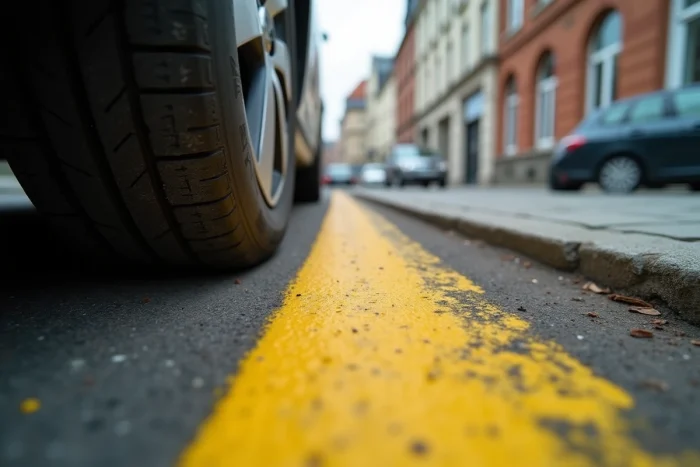
The most common confusion concerns the broken yellow line. Many drivers believe it prohibits any immobilization. This is not the case: stopping is allowed on a broken yellow line, provided the driver remains close to the vehicle and the immobilization is brief.
The Highway Code defines stopping as a momentary immobilization, with the engine able to remain running, to let a passenger get on or off or to load/unload the vehicle. As soon as the driver leaves the vehicle or the immobilization is prolonged, the stop becomes parking, and the offense is constituted.
On a solid yellow line, this distinction disappears. Neither stopping nor parking is tolerated. Even a stop of a few seconds with hazard lights activated remains an infraction. The yellow zigzags follow the same logic: they protect areas with critical visibility (near schools, bus stops), where any immobilization compromises the safety of pedestrians and other users.
The yellow marking on the ground remains one of the few areas where a simple variation in marking (solid or broken) radically changes the nature of the offense and the amount of the penalty. With the generalization of automated controls, the margin of error tolerated by municipalities tends to decrease each year.