
Technical drawing, editorial illustration, and concept art require distinct skills, linked to professional fields that do not share the same opportunities or statuses. Choosing a path implies understanding these differences before committing to training.
Artist-author status or micro-enterprise: the administrative choice that shapes the career
Before even discussing the profession, we recommend addressing the question of status. An illustrator who sells original creations (boards, covers, posters) may fall under the artist-author regime, managed by the Maison des Artistes or Agessa. This regime grants access to specific social contributions and, in case of cessation of activity, to the independent worker allowance under certain conditions.
A graphic designer who produces communication materials for clients (logos, charters, layouts) works more as a service provider. The micro-enterprise status is therefore more suitable. Both statuses can be combined as long as invoices, income, and the nature of services are clearly separated.
This point is almost never addressed in curricula, yet it determines taxation, social coverage, and the ability to invoice certain types of orders. Those considering becoming an illustrator or concept artist when they have loved drawing for a long time would benefit from integrating this dimension from the beginning of their journey.
Concept art and video games: a market that has become very selective

Concept art massively attracts drawing enthusiasts, driven by the image of a continuously growing sector. The reality of the French market is more contrasted. Job offers in video games dropped from 2,716 in 2022 to 799 in 2025, representing a 71% decrease in recruitment. Economic activity remains strong, but studios are internalizing less and outsourcing more to experienced freelancers or specialized studios abroad.
A beginner concept artist thus finds themselves in direct competition with senior profiles available after waves of layoffs. We observe that recruited candidates master both traditional drawing, digital painting, and 3D tools like Blender or ZBrush, used to lay the groundwork for composition before the final rendering.
Specialization remains a lever for insertion. Profiles oriented towards environment design or creature design find missions more easily than generalists, because these skills are difficult to automate and correspond to recurring needs in pre-production.
Long training or self-taught paths in concept art
Schools offering specialized master’s degrees in video games or animation train for four to five years, with significant tuition fees. A structured self-taught path (online mentoring, intensive workshops, portfolio built on professional briefs) can achieve the same result if the candidate demonstrates true production rigor.
What makes the difference in hiring is the portfolio, not the diploma. But a professional portfolio is not just about pretty images: it must show a process (research, iterations, final version) and an ability to meet a specifications document.
Generative AI and professional drawing: adapting practice rather than suffering
Generative AI has changed the conditions of professional drawing practice in just a few months. French local authorities are already using AI-generated visuals for their communication, which has provoked strong reactions from professional graphic designers and illustrators.
In response, the “Human-Made” label, created in 2024, allows creators to declare that their creative process did not involve generative AI. This label does not constitute an official certification, but it responds to a growing demand for transparency from publishers and agencies.
In practical terms, the most exposed professions are those where the deliverable is a generic visual (stock images, icons, stock illustrations). Professions where the designer brings a unique artistic direction, visual storytelling, or technical expertise (storyboarding, character design with anatomical coherence, scientific illustration) remain difficult to replace with a prompt.
Skills to strengthen in the face of automation
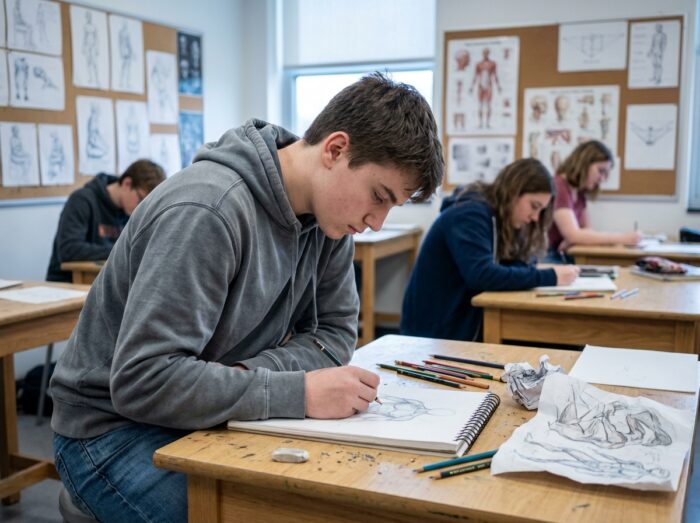
- Mastery of observational drawing and anatomy, as it allows for correcting and refining what an AI produces in a rough manner
- Art direction: knowing how to brief, select, and retouch a rendering, whether human or generated
- Sequential visual storytelling (storyboarding, comics), where coherence between shots remains beyond the reach of current tools
- The ability to work iteratively with a client, incorporating precise feedback on technical details
Career change towards drawing professions: what changes after 25 years
Transitioning to a creative profession requires a different framework than that of a student in initial training. Short professional training programs (six months to a year) are multiplying in graphic design, digital illustration, and animation, often eligible for CPF.
The classic trap is aiming for a “passion” job without checking the reality of the local market. A freelance children’s illustrator in Paris does not have the same prospects as in the regions, where publishing houses and agencies are rare. Web design, motion design, or UX design offer more regular opportunities for a transitioning profile, provided one accepts that drawing is just one tool among others.
The candidates in transition who succeed best are those who combine their previous expertise (architecture, engineering, communication) with a graphic skill. A former building technician training in interior architectural drawing brings a technical credibility that a pure creative coming straight out of school does not have.
The boundary between drawing professions blurs year after year. Hybrid profiles, capable of navigating between illustration, graphic design, and 3D production, find their place more easily than a mono-tool specialist. Building a professional path around drawing remains viable, as long as this passion is treated as an economic project as much as an artistic one.