
The diamond of a Marley turntable is not chosen at random. Between mechanical compatibility with the tonearm, the type of stylus, and the direct impact on sound reproduction, several technical parameters deserve to be compared before any purchase. This article measures the concrete differences between the options available for House of Marley turntables, notably the Stir It Up.
Tracking Force and Compliance: What the Marley Arm Requires from the Diamond
House of Marley turntables use a relatively lightweight tonearm, with a preset or adjustable tracking force within a limited range. This parameter directly conditions the choice of the replacement cartridge.
A cartridge with compliance (flexibility of the cantilever) that is too low for a lightweight arm causes poor tracking of the groove. The diamond skips or applies uneven pressure, which accelerates vinyl wear. Conversely, too high compliance on a heavy arm generates unwanted resonances in the low frequencies.
For the Stir It Up, the original cartridge is standardly equipped with a conical diamond. Before changing the diamond of a Marley turntable, it is essential to check that the replacement cartridge respects the tracking force range of the arm. Audio-Technica cartridges from the VM95 series are among the most frequently cited options as compatible by Marley turntable users.

Conical, Elliptical, or Nude Diamond: Comparison Table of Stylus Profiles
The profile of the diamond determines the contact surface with the record groove. The finer and more precise this surface is, the more detail the playback captures in the high frequencies. Each profile has distinct characteristics in terms of audio rendering and lifespan.
| Diamond Profile | Contact Surface | Sound Rendering | Vinyl Wear | Estimated Lifespan |
|---|---|---|---|---|
| Conical (spherical) | Wide | Less detailed in the highs | More pronounced wear | Longest |
| Elliptical | Finer | Better channel separation | Moderate | Average |
| Nude (bare diamond) | Very fine | Precise and airy reproduction | Reduced | Variable depending on the mounting |
The elliptical diamond offers the best compromise between playback quality and longevity for an entry-level Marley turntable. The transition from a conical to an elliptical is clearly noticeable on well-pressed records, with a wider soundstage and better-controlled sibilances.
The nude diamond, mounted directly without an intermediate metal rod, reduces moving mass. The cantilever transmits the signal with less inertia. This type of mounting remains more fragile and costs more.
Signs of Diamond Wear on a Marley Turntable
Identifying the right time to replace the diamond avoids two problems: a gradual degradation of sound that the ear compensates for without realizing it, and irreversible damage to the grooves of the records.
Symptoms to watch for:
- Audible distortion in high dynamic passages, especially at the end of a side, where the linear speed of the groove decreases
- Excessive sibilance on vocals (the “s” and “ch” become harsh or spit)
- Loss of definition in the highs, a sense of sonic veil on records that are otherwise in good condition
- Recurring groove skips on vinyl without visible scratches
A worn diamond damages the grooves permanently. A record damaged by a dull stylus will not regain its original quality, even with a new diamond. It is better to replace the stylus a bit too early than too late.
Record Maintenance and Impact on Diamond Longevity
Dust accumulated in the grooves acts as an abrasive. Each particle trapped between the diamond and the vinyl accelerates the erosion of the stylus. Systematic brushing of the record before each listening session, with an anti-static carbon fiber brush, significantly extends the lifespan of the diamond.
Never blow on a record to dust it off: the moisture from breath encourages particle adherence. Wet cleaning with an appropriate liquid remains the most effective method for heavily soiled vinyl.
Replacing the Diamond on the Stir It Up: Technical Gesture and Precautions
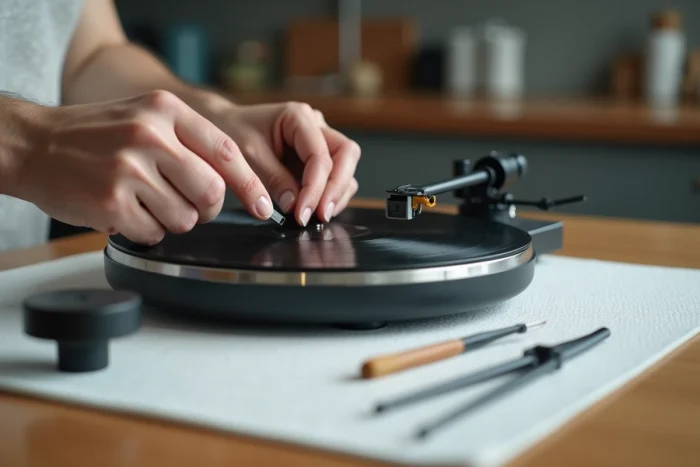
The cartridge of the Marley Stir It Up turntable can be disassembled without tools. The cartridge holder detaches from the arm by a forward sliding motion. The stylus is removed by gently pulling on the stylus housing, perpendicular to the body of the cartridge.
Some precautions to follow during handling:
- Unplug the turntable before any intervention to avoid unwanted signal in the speakers
- Never touch the diamond tip with fingers, as skin oils alter the contact and can bend the cantilever
- Ensure that the new stylus clicks into place firmly, without lateral force
Replacing just the stylus is sufficient in most cases. Replacing the entire cartridge only makes sense if the cartridge body is damaged or if the goal is to upgrade to a higher-end model with a different type of generator (switching from a moving magnet to a moving coil, for example).
Audio-Technica Cartridge on Marley Turntable: Compatibility
The Audio-Technica VM95 series uses a standard half-inch mount, compatible with most Marley turntable arms. The VM95 cartridge body accepts several interchangeable styluses (conical, elliptical, Shibata), allowing for an upgrade in playback quality without having to buy a complete cartridge.
Each VM95 stylus is identifiable by its color: green corresponds to the conical, red to the elliptical. This system simplifies the choice and avoids ordering errors.
The diamond of a Marley turntable can be replaced in a few seconds, but the choice of stylus profile and checking mechanical compatibility with the arm determine the listening quality for several hundred hours. Opting for an elliptical diamond on the Stir It Up represents the most noticeable sound gain compared to the original conical, without altering the rest of the audio chain.