Domestic organization relies on technical principles often overlooked by mainstream guides: accessibility of storage areas, flow of movement between rooms, air quality related to clutter. Here we address the concrete levers that sustainably transform the functioning of a home, far from recycled tip lists.
Universal accessibility of storage: the NF P 99-611 standard applied daily
The NF P 99-611 standard of 2022, published by AFNOR, governs the design of accessible housing. Its principles of storage height, visual contrast, and effortless opening systems are not only relevant for people with reduced mobility. We recommend applying them to every household to reduce fatigue related to repetitive movements.
Placing everyday items between 60 cm and 140 cm from the floor eliminates unnecessary bending and stretching. High kitchen cabinets then serve exclusively for seasonal storage. This logic of vertical zoning by frequency of use changes the fluidity of morning routines.
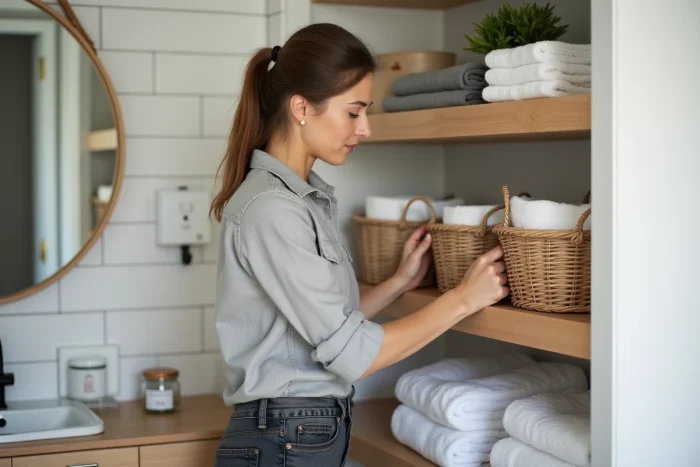
The visual contrast between containers and the background of shelves makes spotting items effortless without cognitive strain. Distinctly colored bins in an entryway closet allow for the separation of winter accessories, reusable bags, and rain shoes without reading a label. This is a principle of sensory ergonomics that decor articles rarely mention.

Before purchasing new storage furniture, a serious sorting of accumulated items remains a prerequisite. Platforms like bazardons.fr facilitate this step by allowing for the quick donation or sale of what clutters, freeing up useful volume in existing cabinets.
Indoor air quality and clutter: what the OQAI shows
The Indoor Air Quality Observatory (OQAI) documented in its national housing campaign that chronic clutter promotes the retention of dust and volatile organic compounds. Overloaded horizontal surfaces become traps for allergens that regular cleaning cannot adequately address.
Specifically, an open shelf filled with knick-knacks accumulates far more particles than a closed cabinet. We observe that homes where free surfaces represent the majority of the countertop or shelves have measurably healthier indoor air.
Reducing clutter is not an aesthetic issue. It is a lever for domestic health that alone justifies rethinking the layout of living spaces.
Identifying critical accumulation areas
Three spaces concentrate the majority of the problem:
- The kitchen countertop, where rarely used appliances, mail, and food products pile up. Clearing this surface reduces the mental load associated with meal preparation.
- The entryway, which often serves as a buffer zone for items in transit (packages, bags, clothing). A system of closed lockers, even narrow ones, transforms this space into a functional vestibule.
- The bedroom, where worn clothes and items without a defined place end up on a chair or the floor. A temporary rack with a strict rule (emptied every Sunday) is enough to break the cycle.
Domestic mental load: structuring the environment as a prevention lever
The High Authority of Health, in its 2023 recommendations on the prevention of psychosocial risks, explicitly advises to structure one’s domestic environment (zones, routines, written tasks) as a lever for preventing burnout. This recommendation places home organization on the same level as work organization.
The link between visible disorder and cognitive overload is direct. Each object without an assigned place generates an implicit micro-decision: to put it away, move it, or ignore it. Multiplied by dozens of objects, this mental background noise exhausts us without our awareness.
Written routines rather than mental routines
We recommend formalizing recurring tasks on a visible physical medium (whiteboard in the kitchen, magnetic sheet on the refrigerator). The gain does not come from the list itself, but from the fact that the brain stops storing tasks in working memory.
A weekly rotation of responsibilities, displayed and non-negotiable each week, reduces friction in households with multiple occupants. The principle is simple: what is written no longer needs to be recalled verbally.

Kitchen layout: workflow and storage by zone
The kitchen concentrates the highest number of daily actions in a often limited space. The classic mistake is to organize cabinets by type of object (plates together, glasses together) rather than by activity zone.
Grouping cooking utensils, oils, and spices in close proximity to the cooking surface avoids unnecessary trips. The same principle applies to the preparation area (knives, cutting boards, mixing bowls) and the breakfast zone (cups, cereals, toaster).
The pantry: visibility before capacity
An effective pantry is based on one principle: everything that is stored must be visible without moving another container. Shallow shelves outperform deep cabinets where products disappear to the back.
- Using transparent containers for dry goods (pasta, rice, flour) allows for stock levels to be spotted at a glance.
- Placing products with short expiration dates at the front, following the “first in, first out” principle used in professional catering.
- Reserving a single bin for children’s snacks and treats, accessible without assistance, to limit requests during work or cooking hours.
Sustainable domestic organization does not rely on the purchase of additional furniture or superhuman discipline. It depends on the design of spaces according to principles of ergonomics, health, and cognitive load reduction, three dimensions that most households can improve without heavy renovations.