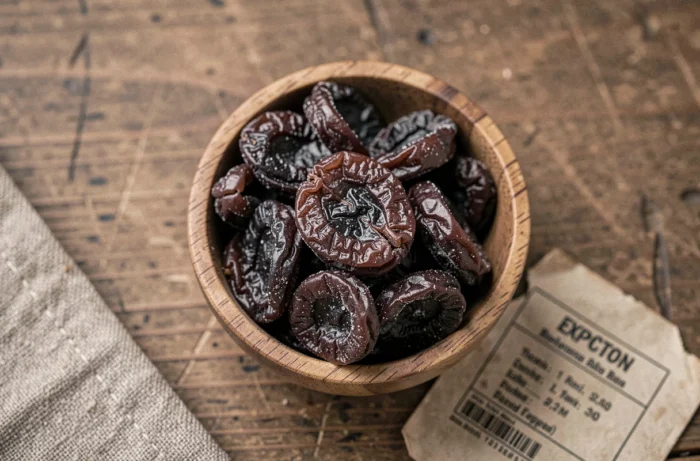
The prunes found at the back of a cupboard, with a date that has passed for several months, raise a recurring question. This dried fruit has a low water content that slows bacterial proliferation, but the date printed on the bag remains a reference that many hesitate to ignore. Understanding what this date really means, and identifying the true signs of degradation, allows for a decision without wasting or taking risks.
DDM or DLC on prunes: what the label really says
The distinction between DDM and DLC radically changes the interpretation of an expired date. The DDM (minimum durability date), preceded by the phrase “best before,” relates to organoleptic quality: taste, texture, color. It does not prohibit consumption after the expiration date.
The DLC (use-by date), on the other hand, signals a real health risk after the indicated day. It applies to fresh and perishable products: meats, dairy products, refrigerated prepared meals.
Prunes, like the vast majority of dried fruits, carry a DDM. Their water activity (aw) is too low for pathogenic bacteria to develop easily under normal storage conditions. A prune whose DDM has passed is not automatically dangerous. It may have lost some flexibility, aroma, or color, but does not necessarily pose a health problem.
One point deserves attention: always check the exact wording. If the packaging states “consume by” followed by a date, it is a DLC, and the product should not be consumed afterward. This case remains rare for commercial prunes, but some prune-based preparations (chocolate-filled, in compote) may carry a DLC due to added perishable ingredients.
Better understanding the consumption of expired prunes starts with this careful reading of the label, even before opening the bag.
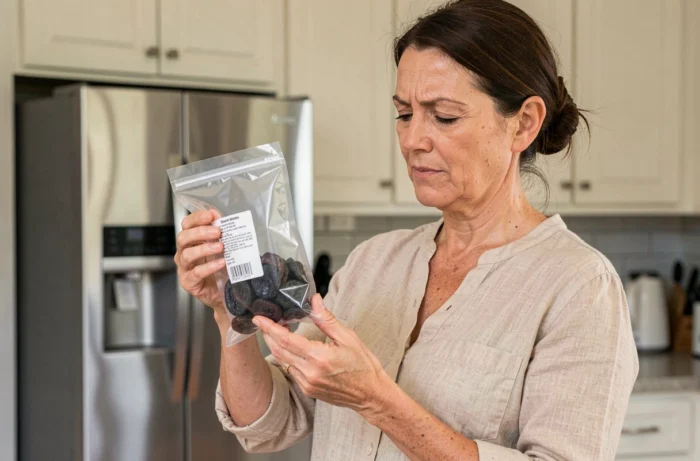
Mold and mycotoxins: the real risk of poorly stored prunes
The danger comes not so much from the date as from the storage conditions after opening. A poorly sealed bag, stored in a warm or humid place, can encourage the growth of mold and yeast, even on a product that is naturally less perishable.
The USDA Agricultural Research Service reminds us that certain fungal toxins can be produced after harvest and that drying reduces the risk without necessarily eliminating it. On a prune, visible mold on the surface is not limited to the colored area: mycotoxins can penetrate beyond the immediately affected part.
This point has a direct practical consequence: one single moldy prune justifies throwing away the entire contents of the bag. Removing the affected fruit and consuming the others exposes you to invisible toxins. Mycotoxins are resistant to cooking, which means that incorporating suspicious prunes into a cake or stew does not neutralize the problem.
Concrete warning signals to check
Before consuming prunes whose DDM has passed, a quick sensory examination is sufficient in most cases:
- Presence of visible mold (white, green, or gray fuzz) on one or more fruits, including inside the bag.
- Sour, fermented, or unusual smell upon opening, indicating advanced microbial activity.
- Abnormally sticky or moist texture, indicating a reabsorption of moisture conducive to fungal development.
- Presence of insects or larvae (food moths), common in dried fruits stored for long periods at room temperature.
If none of these signals are present, the prune has probably lost some taste quality but remains consumable. A prune that has simply hardened or darkened in color does not pose a proven danger.
Expired prunes and food waste: a nuanced arbitration
The question of expired prunes is part of a broader debate on waste related to the confusion between DDM and DLC. Many dried foods (dried fruits, pasta, rice, legumes) end up in the trash when only their taste quality has declined.
For prunes, storing them in an airtight container, in a dry place away from light extends their shelf life well beyond the displayed DDM. Organic prunes, often packaged without preservatives or coating agents, may dry out faster but do not pose a higher health risk if storage conditions are respected.
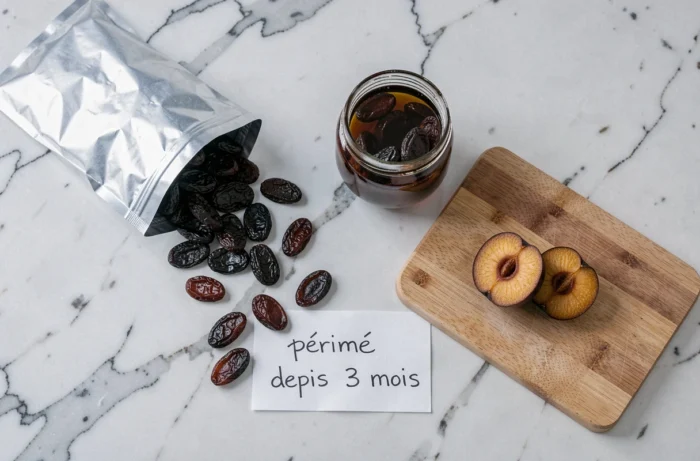
Reusing dried-out prunes
Prunes that have hardened in texture can be rehydrated. Soaking them in warm water or fruit juice for one to two hours restores enough flexibility for cooking. They are then suitable for compotes, tagines, or meat fillings, where the original texture matters less.
However, if the prunes have a rancid taste or unusual bitterness, it is better not to use them. This type of alteration, linked to the oxidation of residual lipids, is not dangerous in itself but makes the product unpleasant and may mask other degradations.
Expired dried fruits: are prunes a special case?
Prunes share the same conservation logic as dried apricots, dried figs, or raisins. All carry a DDM, all store better in a dry and cool environment, and all can be consumed after the indicated date if no signs of deterioration are present.
A particularity of prunes lies in their naturally high sorbitol content, a polyol with laxative properties. This trait does not change food safety after the DDM, but it may surprise anyone consuming a large quantity after finding a forgotten stock.
The available data do not allow for a universal duration beyond which a prune would become unfit for consumption. It all depends on the original packaging, its integrity, and the actual storage conditions. An unopened bag, kept in a temperate cupboard, remains reliable much longer than an opened bag left near a heat source.
The most reliable reflex remains sensory: look, smell, touch. If doubt persists despite reassuring visual examination, throwing away the product is a reasonable precaution, especially for immunocompromised individuals, young children, or pregnant women, for whom even low exposure to mycotoxins should be avoided.