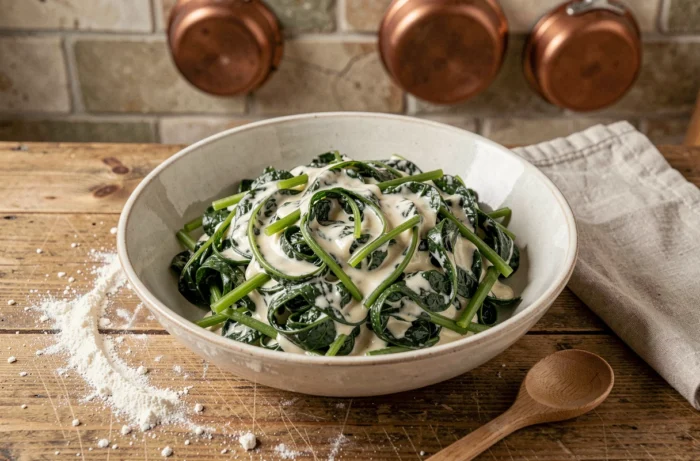
Creamed spinach is among the most commonly prepared recipes in home cooking. However, the choice of cooking liquid, whether milk or cream, radically alters the texture, taste, and even the nutritional interest of the dish. Understanding what happens in the pan or pot allows for precise results every time.
Oxalates and calcium: what milk or cream really changes in your spinach
Have you ever noticed a slight gritty sensation in your mouth after eating plain spinach? These are oxalates, natural compounds found in the leaves. These molecules bind strongly to the calcium present in the spinach itself, making this calcium poorly absorbed by the body.
Adding a dairy product (milk or cream) does not magically release the calcium trapped in the spinach. However, the dairy product provides distinct and more absorbable calcium. Some of this calcium can also bind to oxalates in the intestine, limiting their absorption. For those prone to calcium oxalate stones, this combination is particularly interesting, though it should not replace medical advice.
To significantly reduce the content of soluble oxalates, blanching in water followed by draining is more effective than simply cooking in a pan. Blanching the leaves for a few minutes in a large amount of water, draining them, and then cooking them with cream or milk: this is the most nutritionally relevant sequence.
When you want to make a good choice between milk and cream, the nutritional question already guides part of the answer. But texture and taste are just as important.

Texture and taste of spinach: fluid milk or enveloping cream
Milk creates a light, almost liquid sauce. This is an advantage if you are looking for a subtle accompaniment that keeps the vegetal taste of spinach in the foreground. The downside: without a thickener or reduction, the preparation remains watery and can make a pasta dish soggy or drown a fish.
Cream provides a more stable and coating texture, which holds on the plate without running. It envelops each leaf in a fatty film that softens the bitterness. In return, it masks the fresh spinach’s green, herbaceous flavor more.
When to favor milk
- For a light spinach puree, meant to accompany white fish or steamed poultry, where the sauce should not dominate
- When preparing a gratin or quiche: milk, mixed with eggs, creates a soft batter that cooks without greasing
- If you want a lower-calorie dish while maintaining sufficient creaminess with a bit of butter or nutmeg
When to favor cream
- For a spinach dish served alone as a side, where the sauce needs to have body and not release water on the plate
- In combination with fresh pasta, rice, or red meat, where the fat from the cream acts as a binder between the elements of the dish
- When cooking frozen spinach, which releases a lot of water upon thawing: cream compensates for this dilution better than milk
Cooking spinach with cream: the method that avoids mush
The classic trap with spinach, whether fresh or frozen, is overcooking. The leaves wilt very quickly and release a surprising amount of water. If you pour in the cream too early, it dilutes in the vegetable juice.
First, wilt the leaves dry or with a knob of butter, over medium heat, for a few minutes. Then gently press them with a spatula to release the excess water. It is only at this stage that the cream (or milk) comes into play.
With cream, count on a short cooking time after adding it: the sauce thickens naturally and coats the leaves. With milk, it needs to reduce longer, or you can add a spoonful of flour or starch to achieve a comparable consistency.
The role of butter and aromatics
Butter, added at the beginning of cooking, brings a nutty flavor that complements the green taste of spinach well. A crushed garlic clove in the warm butter, before adding the leaves, transforms a basic dish into a flavorful accompaniment.
Grated nutmeg remains the best ally for creamed spinach, regardless of the base chosen. A pinch is enough. It softens the natural bitterness of the leaves and highlights the roundness of the dairy product.
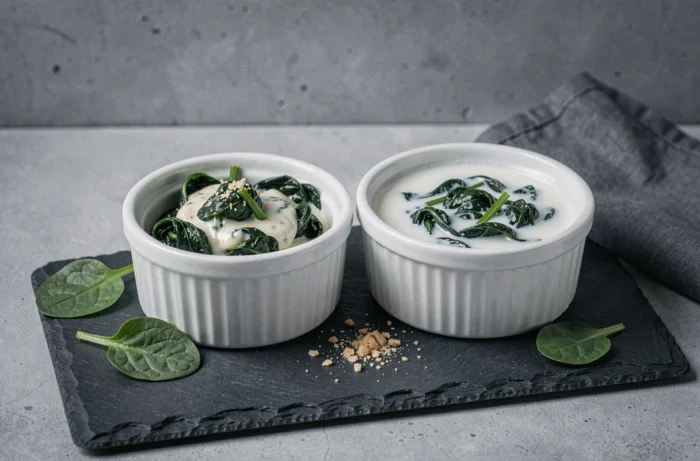
Fresh or frozen spinach: adapting the choice of cream or milk
Fresh spinach loses a lot of volume when cooked. A large bunch reduces to just a few spoonfuls once wilted. Their taste is finer, more herbaceous. With fresh leaves, milk allows this subtlety to shine through better.
Frozen spinach, often sold in chopped portions, releases a lot of water upon thawing. Cream compensates for this dilution and provides a homogeneous result without additional handling. It’s the simplest combination for a quick weekday dish.
In both cases, draining remains a step not to be overlooked. For frozen spinach, letting it thaw in the refrigerator and then pressing it in a colander removes most of the water. For fresh spinach, blanching followed by squeezing in a clean cloth produces a dry base, ready to absorb the cream or milk.
The choice between cream and milk for your spinach ultimately depends on three criteria: the desired texture, the dish it accompanies, and the type of spinach used. Milk is suitable for light preparations and cooking mixtures, while cream is essential when the sauce needs to stand alone. Both options benefit from good draining, or even blanching, for a clean result in the mouth.